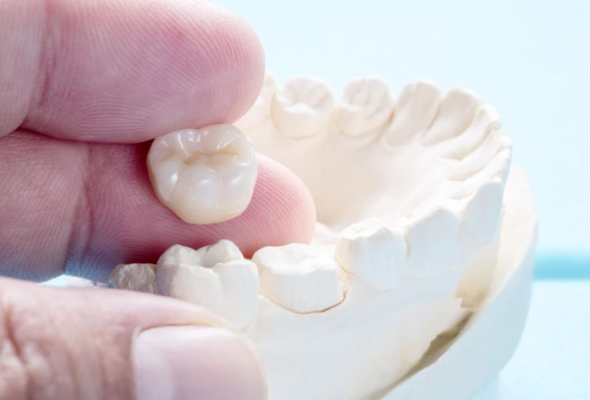
Dental inlays and onlays are indirect restorations for posterior teeth that preserve more healthy tooth structure than a full crown. For dental clinics, they offer a predictable way to restore moderate decay, fractured cusps, or failing large restorations while maintaining the natural contour and strength of the remaining tooth. This page outlines the inlay and onlay options available from our Shenzhen-based dental laboratory, founded in 2012, and how our CAD/CAM digital workflow supports precise, repeatable results for dentists and clinics in 30+ countries.
When Clinics Choose Inlays and Onlays
Inlays and onlays are often selected when a tooth has moderate decay or damage but does not require full-crown coverage. An inlay fits within the cusps; an onlay extends over one or more cusps to protect weakened tooth structure. This makes them a conservative alternative to crowns in cases where sufficient enamel and dentin remain.
For dentists and clinics, the decision typically centers on:
- Preserving cusps and marginal ridges whenever possible.
- Replacing large amalgam or composite restorations that no longer support the tooth predictably.
- Restoring posterior teeth with a minimally invasive philosophy.
- Avoiding unnecessary crown preparation when a partial-coverage restoration is clinically appropriate.
Because inlays and onlays are fabricated outside the mouth, they allow for controlled material selection, detailed anatomy, and stable contacts. They are commonly used in posterior restorations where esthetics, wear resistance, and tooth conservation are all priorities.
Materials for Inlays and Onlays
We fabricate ceramic and composite inlays and onlays to match clinical requirements, preparation design, and the desired balance of esthetics and function.
Ceramic Inlays and Onlays
Ceramic restorations are a frequent choice for posterior partial-coverage cases. They can be designed to blend with natural tooth color while restoring occlusal anatomy and proximal contacts. Ceramic inlays and onlays are suitable when clinics want a durable, esthetic option for moderate to large posterior restorations.
Lithium-Disilicate (Emax) Options
Lithium-disilicate materials, including Emax, are available for inlay and onlay cases where a glass-ceramic restoration is preferred. Emax is a lithium-disilicate material technology; we design and fabricate it according to the submitted case and clinical requirements. This option is often considered for restorations that need to combine esthetic appearance with reliable seating and function.
Composite Inlays and Onlays
Composite inlays and onlays offer an alternative for clinics seeking a tooth-colored partial restoration with a different material profile. They can be useful in selected posterior cases and are fabricated through the same digital workflow to support fit and occlusion.
Digital Fabrication: CAD/CAM Precision and Control
Our laboratory is built around CAD/CAM digital dentistry. Using Exocad and 3Shape design software, we create inlay and onlay restorations with attention to marginal fit, proximal contacts, and occlusal relationships. Design files are prepared for CAD/CAM manufacturing, including 5-axis milling and 3D printing where applicable.
The digital workflow supports:
- Precise restoration contours based on the submitted case data.
- Controlled contact design for adjacent teeth.
- Occlusal anatomy that follows the dentist's guidance and the opposing dentition.
- Consistent reproducibility for single units or multiple posterior restorations.
For dental clinics, this means the restoration arrives ready for try-in and seating, with the fit and function considerations already addressed in the design stage. Complex cases can be reviewed before fabrication, and material selection can be aligned with preparation design, bonding protocol, and clinical goals.
Indications for Inlays and Onlays
Inlays and onlays are indicated for posterior restorations where partial coverage is preferable to a full crown. Typical situations include:
- Moderate decay that does not compromise the remaining cusps.
- Replacement of large amalgam or composite restorations.
- Cracked or fractured cusps that can be protected with an onlay.
- Minimally invasive dentistry where tooth structure preservation is a priority.
- Restorations requiring stable proximal contacts and detailed occlusal anatomy.
They are not a replacement for every crown indication. When tooth structure is severely compromised, a full-contour crown, zirconia crown, PFM, or implant restoration may be more appropriate. Our laboratory is full-service, so dentists and clinics can choose the restoration type that best matches the clinical situation.
Partnering With Our Dental Laboratory
We are a full-service dental laboratory based in Shenzhen, China, founded in 2012. We fabricate custom dental restorations for dental clinics in 30+ countries, including ceramic and composite inlays and onlays, crowns, bridges, veneers, dentures, and implant restorations. Our digital workflow includes Exocad/3Shape design, CAD/CAM, 5-axis milling, and 3D printing.
For regular inlay and onlay cases, turnaround is about 3 days of lab time. Implant and complex cases require 4+ days. Total turnaround including shipping is about 7 days. Certificates available upon request.
To discuss an inlay or onlay case, request a quote, or ask about material options, contact us at [email protected] or WhatsApp +86 18925410015. Our team works with dentists and clinics to confirm case details before fabrication.