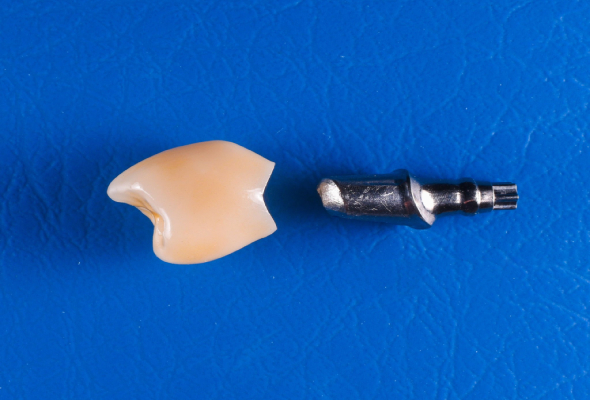
A dental implant crown is the visible, functional restoration that completes implant treatment. The implant fixture provides anchorage, the abutment connects the fixture to the restoration, and the crown restores form, occlusion, and esthetics. Unlike conventional bridgework, an implant crown can replace a missing tooth without preparing adjacent teeth, helping preserve healthy enamel and natural tooth structure. Our full-service dental laboratory, founded in 2012 in Shenzhen, China, fabricates custom dental implant crowns and related implant restorations for dental clinics in 30+ countries. With a CAD/CAM digital dentistry workflow, we support single-tooth cases through complex full-arch rehabilitation.
Options for Dental Implant Crown Restorations
We fabricate implant crowns in several configurations to match clinical requirements, implant position, and restorative preferences.
- Screw-retained implant crowns: The restoration is secured to the implant or abutment with a screw, often improving retrievability and reducing residual cement concerns. This option can be especially useful when implant angulation, tissue depth, or maintenance access favors a screw channel.
- Cement-retained implant crowns: The crown is cemented onto an abutment. This can provide flexibility in esthetics, contour, and occlusion, but cement management and margin placement require careful planning.
- PFM implant crowns: A metal substructure with layered porcelain offers strength, predictable fit, and a broad range of shade options. PFM implant crowns remain a reliable choice for many posterior and multi-unit applications.
- Zirconia implant crowns: Full-contour or layered zirconia provides high strength, biocompatibility, and natural translucency. Zirconia implant crowns are suited to anterior and posterior cases where esthetics and durability are both priorities.
- Single-tooth and multi-unit restorations: We produce single implant crowns, implant bridges, and full-arch solutions, including full-arch implant restorations.
Each dental implant crown is designed around the specific implant platform, abutment, and case requirements provided by the clinic. Material options include full-contour zirconia, layered zirconia, PFM, and lithium-disilicate (Emax) where the case indicates it. Emax is a lithium-disilicate material technology.
Clinical Considerations for Implant Crowns
Successful implant crown restorations depend on more than material selection. The laboratory must translate clinical data into a restoration that fits the implant platform, supports the soft tissue, and functions within the occlusal scheme.
Emergence profile. The contour of the restoration as it leaves the implant and transitions through the soft tissue affects hygiene, esthetics, and tissue stability. Digital design allows us to shape the emergence profile around the scanned tissue condition and the planned abutment.
Occlusal scheme. Implant crowns should be integrated into an occlusion that distributes forces appropriately. We consider contact intensity, excursive movements, and opposing dentition when designing the restoration. For multi-unit and full-arch cases, occlusal planning is coordinated with the clinic's restorative plan.
Passive fit on implant platforms. Passive fit is critical, particularly for screw-retained and multi-unit implant restorations. Poor fit can introduce stress at the implant-abutment interface. Our digital workflow uses Exocad or 3Shape design, CAD/CAM fabrication, 5-axis milling, and 3D printing to support precise abutment and crown interfaces.
Material and retention planning. Retention method, material choice, and cement or screw access are reviewed together. For cement-retained cases, we design for controlled cementation and cleanable margins. For screw-retained cases, we plan the screw channel to minimize occlusal interference. For anterior implant crowns, shade matching, surface texture, and translucency are reviewed with the clinic's photographic and shade data. For posterior cases, wear resistance and occlusal stability guide material and contour decisions.
Support for Complex Implant Cases
Implant cases often require additional design and fabrication time. Regular cases take about 3 days of lab time. Implant and complex cases typically require 4+ days of lab time, with total turnaround including shipping about 7 days. More complex full-arch or multi-unit implant restorations may need additional coordination based on component availability and case details.
We work from the scans, models, photographs, and implant component information provided by your clinic. Clear communication on implant platform, abutment type, margin location, shade, and occlusion helps us return a dental implant crown that integrates smoothly into your workflow. For full-arch implant restorations, we can coordinate design, milling, and finishing steps with your clinic's surgical and restorative timeline.
Partnering With Your Clinic
Our laboratory provides dedicated technical consultation for implant cases. Whether you are planning a single implant crown, a screw-retained bridge, or a full-arch restoration, we can discuss retention, material selection, emergence profile, occlusal scheme, and interface requirements before fabrication begins. Certificates available upon request.
To start an implant case or ask a technical question, contact us at [email protected] or via WhatsApp at +86 18925410015.